Choosing the Best Batteries for All-Day Vaping

Let’s be honest: nothing frustrates vapers more than a device dying halfway through the commute home on the 401, or right before lunch break when cravings hit hardest. That sinking feeling when the device blinks red at 2 PM with hours left in the day? For former smokers, especially, a dead battery becomes more than just an inconvenience. It’s a genuine risk. When the power source depletes completely and stress levels spike, that corner store selling cigarettes starts looking awfully tempting again.
All-day vaping success isn’t about buying bigger batteries. Seven years of helping GTA customers at Majestic Vapes in Brampton and Mississauga have revealed that successful battery management comes down to understanding actual usage patterns (typically 150-400 puffs daily, depending on former smoking habits), planning for Ontario’s weather extremes, and having the right backup strategy for specific lifestyles. This guide breaks down practical strategies that actually work for real people with real daily routines.
Shop now in the #1 Online Vape Shop in Canada
We Ship Anywhere in Canada Including Quebec
Disclaimer: Battery performance, capacity ratings, and lifespan characteristics change frequently. All information is based on available 2025 data and should be verified with current sources before making battery purchases. Individual battery life varies significantly based on usage patterns, device settings, environmental conditions, and battery age.
Pricing and Product Availability Disclaimer: All product prices, specifications, and availability mentioned in this guide are subject to change without notice. Prices listed reflect approximate retail pricing in the Greater Toronto Area as of early 2025 and may vary by retailer, location, sales promotions, and market conditions. Always verify current pricing, product availability, and specifications with Majestic Vapes or authorised retailers before making purchase decisions.
Understanding Your All-Day Vaping Needs by Former Smoking Level
How do vapers figure out exactly how much battery capacity they need for all-day coverage? Start by translating old smoking habits into vaping frequency. Someone who smoked a pack a day (20 cigarettes) will likely take 200-300 puffs throughout the day since each cigarette involves roughly 10-15 drags. At Majestic Vapes, customer consultations start with “How much did you smoke?” because that smoking history provides surprisingly accurate clues about battery requirements.
Someone who smoked half a pack (10 cigarettes daily) typically vapes 100-150 puffs throughout the day, while a pack-and-a-half-a-day former smoker (30 cigarettes) might draw 300-450 puffs. Understanding these categories matters because they determine whether simple pod systems work or whether more elaborate removable battery setups become necessary.
Important Note on Product Recommendations: Product recommendations reflect devices and batteries commonly available in early 2025. Vaping technology evolves rapidly, with new models released quarterly and existing models being discontinued or updated. Prices listed are approximate ranges based on typical retail pricing and should be verified before purchasing. Consult with Majestic Vapes staff for current product recommendations, pricing, and availability.
Light Vapers: Former Half-Pack Smokers (80-150 Puffs Daily)
Former smokers who consumed 5-10 cigarettes daily probably fall into the light vaper category at 80-150 puffs throughout the day. If you’re new to vaping and handling batteries, start by learning battery safety fundamentals to ensure proper usage from day one. This usage level works beautifully with simple, compact devices that don’t require complex battery strategies. Think one good pod system or small vape pen with 1,500-2,000 mAh capacity. The reality? Light vapers have it relatively easy, and most built-in battery devices handle these needs without issue.
An 1,800 mAh device runs 12-16 hours on a single charge at typical pod system wattages (12-18 watts), meaning overnight charging covers a wake-up to 10 PM bedtime. Total cost for a complete setup typically runs approximately $40-80 CAD for the device plus around $15-25 weekly for pods if using closed systems like STLTH, or approximately $20-35 monthly for e-liquid with refillable systems.
Consider pod systems like STLTH Type-S (typically around $45-65 CAD, pricing subject to change) or Vaporesso Xros 4 Nano (around $40 CAD). Around Brampton and Mississauga, both locations stock these with staff who can demonstrate them. The first-time customer discount (10% off) makes premium devices more affordable.
The most common mistake: assuming overnight charging can be skipped because “barely using it.” Then Wednesday hits, charging was forgotten, and suddenly the battery sits at 15% during the afternoon commute. Build the charging habit now while usage remains light. What successful light vapers discover: keeping a disposable vape as backup in the car or desk drawer (approximately $25-35 CAD, lasting months as an emergency backup) eliminates anxiety completely.
Moderate Vapers: Former Pack-a-Day Smokers (180-280 Puffs Daily)
Former pack-a-day smokers (18-22 cigarettes daily) typically land in the moderate vaping category at 180-280 puffs throughout the day. This represents the sweet spot where real choices exist: high-capacity built-in batteries can work with occasional workplace charging, or stepping up to removable battery systems provides true worry-free coverage.
Daily consumption runs approximately 2,200-3,500 mAh, depending on device wattage. A 3,000 mAh built-in battery typically provides 10-12 hours for MTL devices, or around 6-8 hours with DTL setups. Might be enough with lunch break top-up charging for 30-45 minutes (adding approximately 600-900 mAh back).
Look at Vaporesso Luxe X (typically $70-95 CAD) with 2,000 mAh for all-day MTL vaping. Want removable battery confidence? The Vaporesso Gen 200 dual-battery mod (approximately $85-120 CAD) plus four Samsung 30Q batteries (around $60-80 total) plus Nitecore i4 charger (typically $45-60) runs approximately $190-260 CAD but eliminates anxiety forever.
Most moderate vapers struggle because they try making built-in batteries work without developing charging discipline. What’s needed: workplace charging habits or spare batteries. Always verify workplace charging availability before relying on it as the daily strategy.
Heavy Vapers: Former Pack-and-a-Half Plus Smokers (300-450+ Puffs Daily)
Anyone who crushed a pack and a half or more daily (30+ cigarettes) falls into the heavy vaper category at 300-450+ puffs throughout the day. Trying to make built-in batteries work just sets up frustration. Removable battery systems with proper spare battery rotation become necessary.
Daily consumption typically hits approximately 4,500-6,500+ mAh, which means dual-battery mods (6,000 mAh with two 3,000 mAh cells) often last around 10-12 hours. Heavy vapers need proper battery rotation: four to six batteries total, an external four-bay charger for overnight charging, carrying 2-3 charged spares daily in protective cases, and swapping batteries every 4-6 hours before hitting critical levels.
Regional Pricing Variation: Prices listed reflect typical Greater Toronto Area retail pricing as of 2025. Pricing varies significantly by province due to different tax structures, municipal regulations, and market conditions. British Columbia, Alberta, and Quebec residents should verify local pricing as it may differ by 15-30% from Ontario pricing.
Go straight to dual-battery systems: Vaporesso Gen 200 mentioned earlier for the mod, six Samsung 30Q or Molicel P42A batteries (typically $90-130 total), and XTAR VC4 charger (around $50-70 CAD). Total investment typically runs approximately $225-320 CAD upfront but provides 3-5+ years of service.
The biggest mistake: buying a dual-battery mod but only owning four batteries total. Six batteries minimum (two in the device, two immediate spares, two charging at home) enables true worry-free coverage. What experienced heavy vapers discover: numbering all six batteries and rotating strictly in order ensures even wear that may extend total battery life compared to random selection.
Built-in Battery Devices for All-Day Vaping
Built-in battery devices offer serious advantages for many all-day vapers: no spare cells to track and manage, USB-C charging from any power source, and simpler daily management without worrying about battery rotation schedules. For light to moderate vapers, modern high-capacity pod systems provide genuine all-day coverage. The question becomes whether they pack enough capacity for usage levels and whether charging opportunities exist during the day.
High-Capacity Pod Systems (1,500-2,000 mAh Options)
Modern pod systems and vape pens with 1,500-2,000+ mAh built-in batteries typically provide genuine all-day coverage spanning 12-16 hours for light to moderate vapers (100-250 puffs daily). Compare that to the 350-650 mAh pod systems from just five years ago, and the viability of built-in batteries for all-day solutions becomes clear. Capacity has roughly tripled while device size only increased marginally.
For built-in battery users prioritising all-day coverage, STLTH pod systems (420-500 mAh typical) often handle 8-10 hours for light vapers, while Vaporesso Luxe X (2,000 mAh) may extend that to 10-14 hours for moderate users. The biggest advantage? Simplicity. One device, one charging cable, no managing multiple batteries or carrying extras in protective cases.
USB-C Fast Charging Advantages
USB-C fast charging has been a legitimate game-changer. Older micro-USB charging meant 2-3 hours minimum for a full charge, while modern USB-C with Power Delivery support (18-20 watt charging rates) can typically top up a 2,000 mAh battery in under an hour, sometimes 45-50 minutes from empty to full. That makes lunchtime charging actually practical, adding approximately 40-60% capacity back during a 30-minute lunch break.
When Built-In Batteries Work Best
For someone new to vaping who’s transitioning from smoking, the simplicity of built-in batteries often supports better adherence. No overwhelming battery management protocols while still figuring out nicotine salt concentrations (typically 20-50 mg/mL in Canada), device settings, and new habits. At Majestic Vapes, the common recommendation starts with high-capacity built-in devices, then assessing after 2-3 weeks whether graduating to removable battery systems makes sense.
Built-in battery users need to remember: built-in batteries have limited lifespans. Typically, 300-500 charge cycles before capacity drops approximately 30-50%. Learn how to identify when it’s time to replace your battery to avoid unexpected device failures. At that point (usually 12-18 months for daily chargers), the entire device becomes electronic waste since internal batteries can’t be replaced.
Learn how to identify when it’s time to replace your battery to avoid unexpected device failures.
Removable Battery Solutions for Heavy All-Day Vapers
For heavy vapers taking 300+ puffs daily, running higher wattage devices (60-100+ watts), or simply wanting zero battery anxiety throughout 12-16 hour days, removable battery systems change everything. Carrying charged spare batteries means genuinely never risking getting caught with a depleted device, regardless of how long the day runs.
18650 vs 21700 Battery Formats
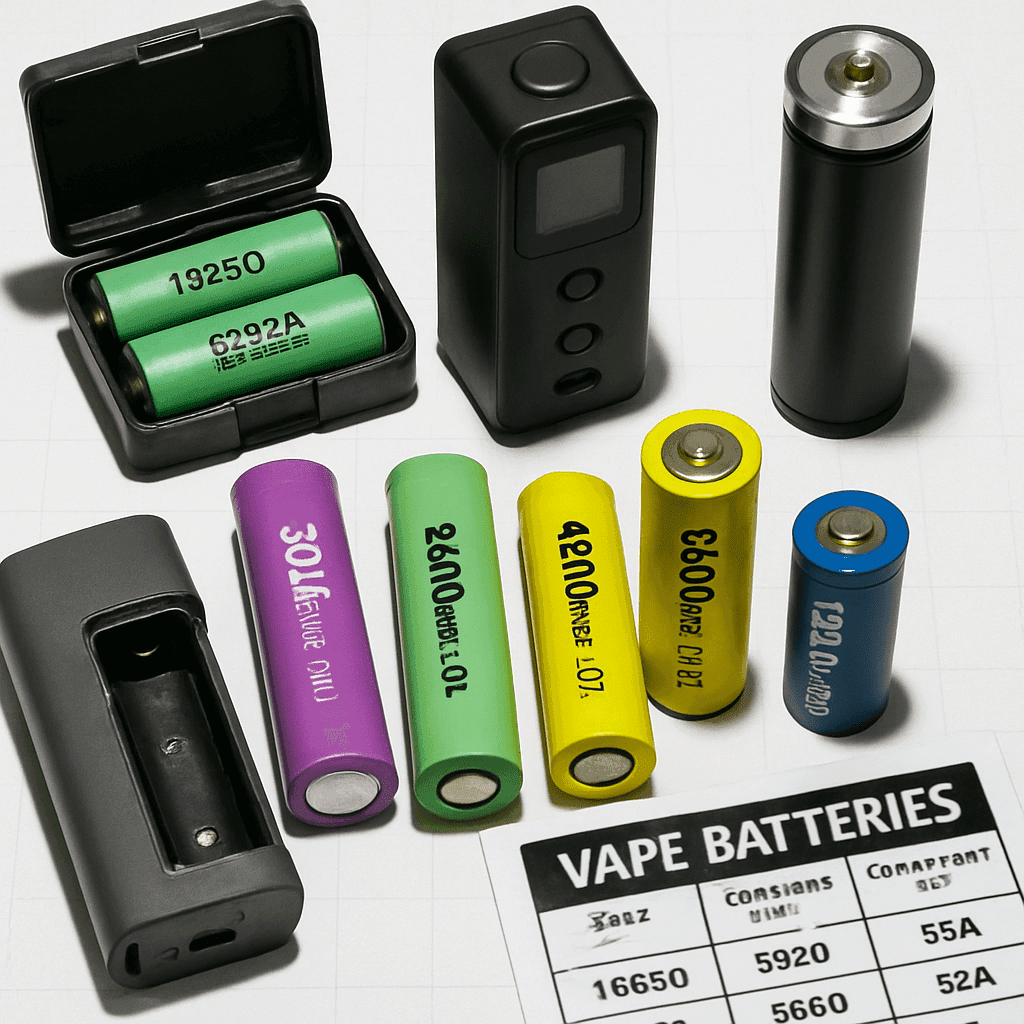
The 18650 and 21700 battery formats (industry-standard rechargeable lithium-ion cells) have become the vaping standard for good reason. If you’re new to choosing the right battery format for your device, understanding compatibility and specifications is essential before purchasing. Available everywhere in Canada (including both Majestic Vapes locations stocking Samsung, LG, Sony, and Molicel brands), they come in various capacities (2,500-5,000 mAh depending on format and model) and discharge ratings (15-30 amps continuous), and remain relatively affordable (typically $12-22 CAD per cell, pricing subject to change).
The 18650 format offers proven reliability with widespread compatibility. Most devices accept them, replacement is easy, and costs stay reasonable. Before purchasing, ensure you’re understanding battery terminal types to guarantee compatibility with your specific mod. The 21700 format provides higher capacity (4,000-5,000 mAh versus 2,500-3,500 mAh for 18650s) in a slightly larger size, meaning potentially 30-40% longer runtime from the same number of cells. Modern mods increasingly support the 21700 format.
Building Your Battery Rotation System
How many spare batteries are actually needed for worry-free all-day vaping? For most people, four batteries total (two pairs) provide excellent coverage without excessive investment. Using a dual-battery mod: two in the device providing 6,000 mAh of active power, two charging at home following proper storage practices for spare batteries, ready for the next day. Single battery mod users often prefer six batteries: one in the device, one in the pocket as an immediate spare, four rotating through the external charger at home, ensuring two fresh cells stay ready for tomorrow.
Building a rotation of 4-6 batteries with an external charger typically costs approximately $80-150 CAD total upfront, but provides essentially unlimited all-day coverage. Swapping fresh cells as needed rather than waiting hours for charging. This rotation ensures never waking up to dead batteries because charging got forgotten.
External Charger Selection Guide
Not investing in a proper external charger (typically $35-75 CAD for quality two-bay or four-bay models from Nitecore, XTAR, or Efest, pricing subject to change) creates problems. USB charging through the mod runs slowly (4-6 hours for dual batteries), ties up the device, and creates unbalanced cell charging that may reduce battery lifespan significantly. Proper charging infrastructure becomes genuinely essential equipment, not optional.
For removable battery systems optimised for all-day coverage, single battery mods with spare batteries work brilliantly for anyone comfortable swapping cells during the day. Dual-battery mods eliminate swapping for most users. 6,000 mAh in the device itself means typical coverage for 12-16 hours regardless of usage patterns.
Power Management for Extending All-Day Battery Life
Optimising power settings can dramatically extend battery life without buying bigger batteries or more spares. Running the device at minimum satisfying wattage often doubles battery life compared to maxing out power for bigger clouds. The difference between 300 puffs and 150 puffs from the same 3,000 mAh battery means approximately four extra hours of coverage just from turning down wattage by 20-30 watts.
Finding Your Optimal Wattage Setting
The relationship between wattage and battery drain isn’t linear. It’s exponential. Going from 40 watts to 80 watts doesn’t drain the battery twice as fast; it may drain it more like 3-4 times faster because of how power draw squares with voltage increases. At Majestic Vapes, the common advice involves experimenting with lower settings for a few days before assuming more battery capacity is needed.
Start at the low end of the coil’s recommended range (check the coil itself, where it’s usually printed, like “0.4Ω 40-60W”). Take several hits (8-10 puffs minimum) to let the coil fully saturate with e-liquid and reach operating temperature, then honestly assess satisfaction with throat hit intensity and vapour production. If it feels satisfying, stop there. No reason to increase power and waste battery. Most people find their sweet spot within 10-15 watts of the minimum recommended range, which often represents approximately 30-40% battery savings compared to running at maximum.
Coil Resistance and Battery Drain
Coil selection influences battery drain just as much as wattage settings. Low resistance coils (0.15-0.25 ohms, designed for sub-ohm cloud chasing) require significantly more power (60- 100+ watts) than higher resistance coils (0.6-1.0 ohms, designed for MTL vaping at 15-30 watts). If all-day battery life matters more than massive clouds, choosing higher resistance coils designed for lower wattage may extend capacity dramatically. Often around 2.5-3x longer battery life in typical usage scenarios while still delivering satisfying throat hits and adequate vapour production.
Device Features That Save Power
Turn off the device completely between uses rather than leaving it in standby mode, consuming 15-30 milliwatts. Every minute powered off saves battery. Some devices offer power-saving modes or sleep timers that automatically shut down after periods of inactivity. Enable these features. Screen brightness also impacts battery life. Dimming the display or using simpler screen modes can add 5-10% more runtime on devices with large colour displays.
Canadian Weather Impact on All-Day Battery Performance
Managing batteries through Ontario’s extreme seasonal variations requires specific strategies because generic advice doesn’t cut it when dealing with temperature swings of 50-60°C between January mornings and July afternoons.
Winter Battery Management (December-March)
How much does cold weather actually affect vaping battery performance in Ontario winters? At -15°C (typical January morning in Brampton or Mississauga), a 3,000 mAh battery may effectively become a 2,000-2,200 mAh battery. That’s approximately 25-35% capacity loss (though this varies by battery chemistry and conditions) from cold-slowed chemical reactions inside the lithium cells, with zero actual battery degradation. The electrochemistry: lithium ions move more slowly through the battery’s electrolyte at low temperatures, increasing internal resistance and reducing the effective voltage the battery can deliver.
For anyone commuting on GO Transit or working outdoors, winter battery management becomes its own discipline. Keep devices inside jacket pockets against body heat (maintaining 20-30°C versus outside pocket temperatures barely above ambient), pre-warm devices for 3-5 minutes near car heaters before relying on them during commutes, carry extra battery capacity specifically for winter months, and never leave devices or spare batteries in cars overnight where they’ll freeze to -20°C.
Starting the day with room-temperature batteries (20-22°C) versus cold batteries (5-10°C) may provide approximately 15-20% more effective capacity immediately. And most people miss this: starting the car 10 minutes before leaving and placing the device near the heater vent while finishing getting ready means leaving with a warm device that performs at full capacity.
Summer Heat Protection (June-August)
Ontario summers bring different challenges. Less about immediate performance loss and more about long-term battery damage from heat exposure. While cold reduces capacity temporarily (performance returns when batteries warm up), prolonged exposure to 40-50°C+ temperatures permanently damages battery chemistry. The critical risk: leaving devices in hot cars where interior temperatures hit 50-65°C within 30-45 minutes in direct sunlight.
Summer management focuses on avoiding heat exposure: never leaving devices in cars during warm days (above 25°C ambient, car interiors hit 45-55°C), keeping devices in climate-controlled spaces when possible, and being mindful during outdoor work about device storage (shade versus direct sunlight makes a 10-15°C difference). If devices must be left in cars briefly, place them in trunks (typically 5-10°C cooler than the interior) or under seats away from direct sunlight.
Seasonal Battery Capacity Planning
At both Majestic Vapes locations, huge spikes in “battery doesn’t last anymore” complaints appear every November when cold hits. Usually, the battery performs fine. People just need winter-specific strategies rather than new equipment. Similarly, increased battery replacements happen every September due to batteries damaged during summer heat exposure. People don’t realise the damage until it falls when batteries suddenly fail prematurely, even though the damage happened months earlier.
Plan battery capacity with seasonal variation in mind. The setup that works perfectly May through October might need supplementation November through March. Consider keeping an extra charged battery specifically for the winter months when the cold reduces effective capacity.
All-Day Charging Strategies and Opportunities
Strategic charging during the day can eliminate the need for bigger batteries or complex spare battery systems for many people. Even 20-30 minutes of USB charging may add approximately 500-800 mAh back to the battery. That’s around 100-150 additional puffs of coverage that might bridge the gap between running out at 4 PM versus making it home at 6 PM.
Workplace Charging Options
Workplace charging at desks via USB ports (either from computers or USB wall adapters) provides the most reliable opportunity. Plug in when arriving at 8-9 AM, the device charges while working through morning meetings and tasks, and battery levels typically hit 80-100% by lunch at noon. This works particularly well for office workers at their desks, 5-7 hours of actual desk time out of 8-hour shifts.
A device that would die by 3 PM without charging often lasts until 6-7 PM with 3-4 hours of desk charging. USB charging typically delivers 0.5-1.0 amps at 5 volts (2.5-5 watts), translating to roughly 400-800 mAh added per hour depending on the charger and device. This makes quick lunchtime top-ups practical for moderate vapers.
Vehicle Charging for Commuters
Vehicle charging during GTA commutes provides a substantial opportunity for drivers spending 60-120+ minutes daily in cars. A 45-minute commute from Brampton to downtown Toronto provides decent charging time if USB charging cables are remembered and car charger adapters exist.
USB car chargers with 2-3 amp output capability typically run around $15-30 CAD and turn every drive into an automatic charging opportunity. Just plug in when starting to drive, and approximately 800-1,200 mAh may get added per hour of drive time. A 90-minute morning commute can often add approximately 1,200-1,800 mAh (roughly 40-60% of a 3,000 mAh battery).
Portable Power Bank Solutions
USB power banks for emergency charging eliminate the “completely stranded with a dead device miles from outlets” scenario everyone fears. A compact 10,000 mAh power bank in a bag can typically fully charge most vape devices 2-3 times, depending on their battery capacity. That’s serious emergency coverage for situations where being away from outlets runs longer than planned.
Full-day music festivals, all-day hiking trips, road trips through areas with limited charging infrastructure, or days when everything goes wrong. Not daily-use items for most people (workplace and vehicle charging handle routine needs), but insurance against worst-case scenarios typically costing approximately $25-60 CAD for reliable models from Anker, RAVPower, or Aukey.
Practical All-Day Vaping Tips from Majestic Vapes Customers
The best advice often comes from people who’ve actually figured out all-day battery management through trial and error. Seven years of helping GTA customers build all-day strategies at Majestic Vapes has revealed what actually works in real daily routines.
Morning Preparation Routine
Charging overnight forms the foundation. Before bed (typically 10 PM-midnight): plug the device into a USB wall charger, put spare batteries on the external charger, check that everything actually charges and doesn’t just sit plugged in without making proper connection (look for charging indicator lights or screen showing charge status). Wake up to fully charged equipment showing 100% capacity, ready for the day.
Packing spare batteries or backup devices goes in the same mental category as grabbing keys, wallet, and phone. It becomes an automatic habit after 2-3 weeks of conscious effort. Many Majestic Vapes customers keep spare batteries (in protective cases, always in cases, never loose to prevent dangerous short circuits) next to their keys or on the table by their door, specifically to build this association through physical proximity.
Emergency Battery Strategies
When batteries die unexpectedly during the day away from outlets or charging infrastructure, options exist. First step: immediately lower the wattage to the absolute minimum satisfying level. Every watt lower extends remaining capacity. Running 55 watts normally? Drop to 35-40 watts even if hits feel weaker. The wattage reduction strategy discussed in the power management section can extend the remaining battery significantly.
Majestic Vapes’ same-day delivery covers genuine emergencies when truly stranded: dead device, no backup, can’t find a charger, can’t make it home. Call either location (Brampton 905-454-3244, Mississauga 905-276-5113) or order online at majesticvapes.ca before 11 AM Monday-Friday. Delivery to Brampton and Mississauga addresses happens the same day, usually within 2-4 hours.
Weekend vs Weekday Approaches
Weekday routines benefit from workplace charging infrastructure and predictable schedules. Weekend all-day outings require different planning. Before leaving home Saturday morning for full-day activities, ensure devices start at 100%, pack all spare batteries, verify portable chargers are fully charged, and consider bringing backup disposable vapes for situations where swapping batteries or finding outlets becomes impractical.
Many successful all-day vapers keep dedicated “weekend kits” packed and ready: portable charger, spare batteries in protective cases, backup disposable, USB cables, and car charger adapter all stored together in a small pouch. Grab the pouch, grab the device, and everything needed for all-day coverage comes along.
Getting Personalised All-Day Battery Advice in the GTA
This guide provides comprehensive strategies covering dozens of scenarios, but specific situations have unique factors that generic advice can’t fully address. Exact daily routines, former smoking amounts, budget constraints, and tolerance for device complexity. These personal variables determine which battery solution actually works best individually.
In-person consultation at Majestic Vapes’ Brampton or Mississauga locations provides value beyond what written guides offer. Staff can assess specific all-day needs through 10-15 minute conversations covering routines and usage patterns, examine current vaping styles, demonstrate devices so handling them reveals size and weight differences between options, and recommend specific setups matched to lifestyles from an extensive inventory.
The connection between reliable all-day vaping and smoking cessation success can’t be overstated. When never getting caught with a dead battery, forcing cigarette temptation during moments of stress or strong cravings, quit attempts become dramatically easier psychologically. That reliability deserves real time and thought invested into getting the battery strategy right from the beginning.
Shop now in the #1 Online Vape Shop in Canada
We Ship Anywhere in Canada Including Quebec
Both Majestic Vapes locations welcome walk-ins during business hours. No appointment necessary. Visit the Brampton location at 4 McLaughlin Rd S #9, Brampton, ON L6Y 3B2 or Mississauga at 1900 Dundas St E Unit 3, Mississauga, ON L4X 2Z4. Contact Brampton at 905-454-3244 or Mississauga at 905-276-5113 for questions before visiting.
Final Disclaimer: This guide serves informational purposes only. Battery performance varies significantly between brands, models, and usage conditions. Always consult current sources and experienced retailers like Majestic Vapes for up-to-date information. Individual results vary based on usage frequency, device settings, environmental conditions, battery age, and personal vaping style.
Financial Information: All prices and cost calculations are approximate and for illustrative purposes only. They reflect typical Greater Toronto Area retail pricing as of early 2025 but do not represent guaranteed pricing. Prices vary by location, retailer, promotions, and market conditions. Verify all pricing and availability directly with retailers before purchasing.